

 CoinFo_Admin
 In the early days of digital finance, innovation was visible. Faster payments, sleeker interfaces, cheaper cross-border transfers — progress you could measure in seconds and basis points.
But the most important shift happening today is harder to see.
It’s not about how fast money moves.
It’s about who — or what — decides where it moves.
A decade ago, financial systems were built to execute instructions. Humans analyzed, approved, and acted. Technology followed.
Today, that hierarchy is quietly reversing.
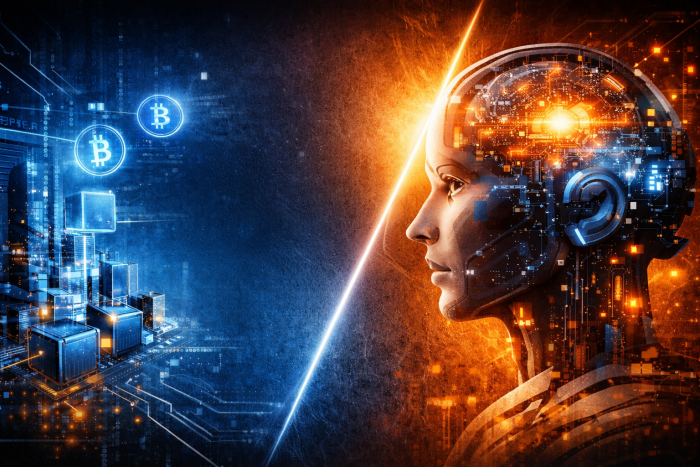
AI systems are no longer just supporting decisions — they are starting to make them.
They monitor risk in real time.
They detect anomalies before they escalate.
They rebalance portfolios without waiting for human input.
And crucially, they do it continuously.
“The most powerful financial systems of this decade won’t be the fastest — they’ll be the ones that think.”
This is where a second force enters the picture: crypto infrastructure.
Because intelligence alone is not enough.
Decision-making requires execution.
Traditional financial rails were never designed for autonomous systems. They operate within constraints: limited hours, intermediaries, fragmented jurisdictions.
Crypto changes that.
It offers a settlement layer that is:
- Always on
- Instantly executable
- Programmable by design
For the first time, financial decisions and financial execution can exist in the same loop — without delay.
A Structural Shift
| Layer | Traditional Finance | Emerging Model |
|---|---|---|
| Decision-Making | Human-driven | AI-driven |
| Execution Speed | Batch / delayed | Real-time |
| Infrastructure | Fragmented, intermediated | Unified, on-chain |
| Operating Hours | Limited | 24/7 |
| Capital Allocation | Periodic | Continuous |
What emerges is something fundamentally different from both fintech and crypto as we’ve known them.
Not just programmable finance.
Autonomous finance.
In this model:
- Payments trigger themselves based on conditions
- Treasury systems rebalance dynamically
- Risk is priced and managed continuously
There is no clear “start” or “end” to a process — only ongoing optimization.
For institutions, this is not just a technological upgrade. It’s a strategic inflection point.
The advantage will no longer come from access to capital or even access to markets.
It will come from how intelligently capital is deployed.
Firms that integrate AI into their core systems — and pair it with programmable, real-time infrastructure — will operate on a different timescale altogether.
Others will still be making decisions in cycles, while the market moves in flows.
The transition won’t be announced.
There won’t be a single moment where everything changes.
Instead, it will feel gradual — until suddenly, it isn’t.
Because once financial systems begin to think and act on their own, the question is no longer about efficiency.
It becomes something more fundamental:
Who designs the logic that moves capital — and who is left reacting to it?